
Oct 2026
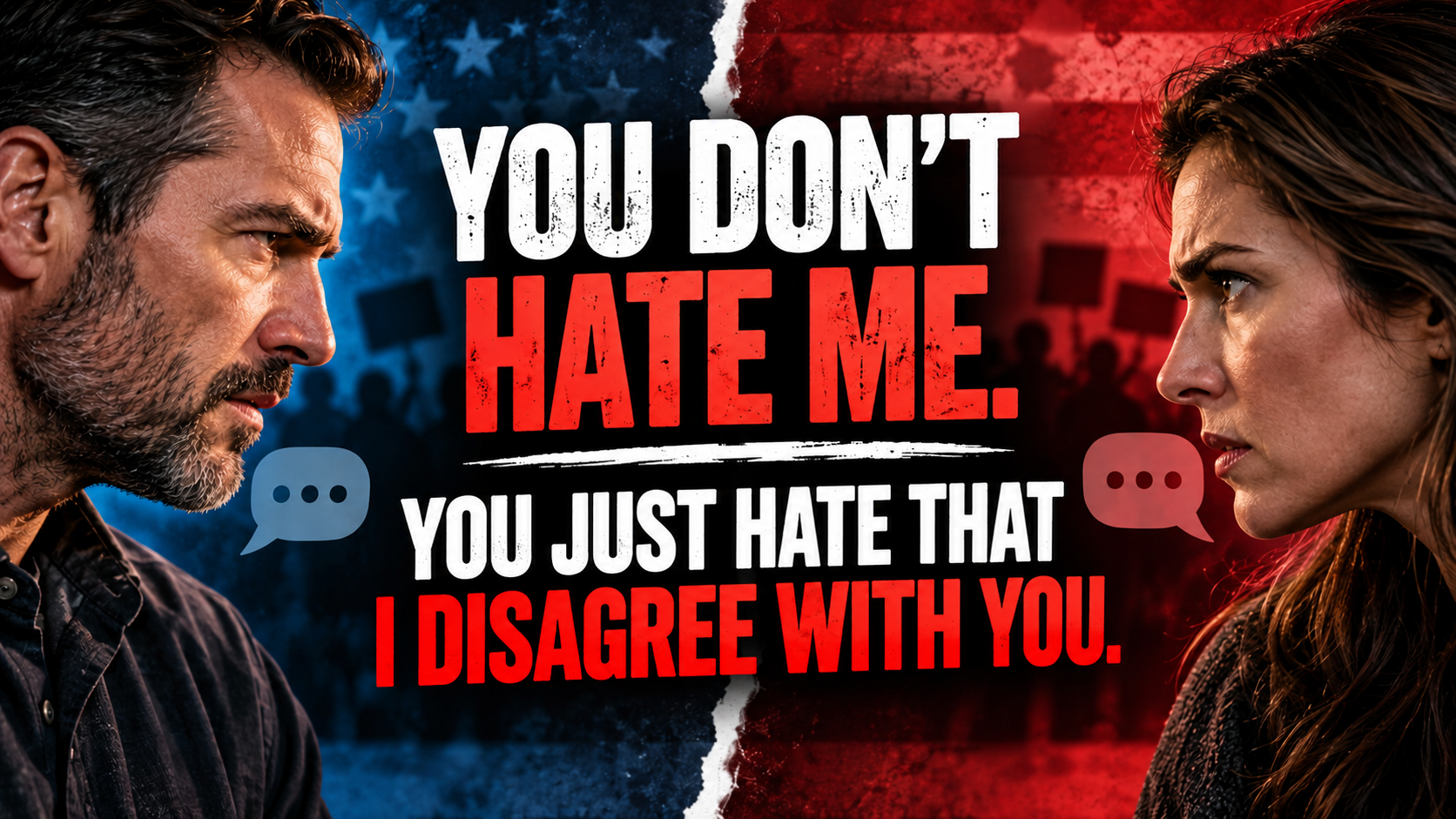
You Don’t Hate Me. You Just Hate That I Disagree With You.
When did disagreement become hatred? What three decades at the kitchen table taught me about why no one likes to be backed into a corner.
Rising gas prices. Increasing grocery bills. Interest rates and mounting debt. These, among many other topics, have become the center of debate over the past few months in America.
As inflation increases and our paychecks remain stagnant, many of us are feeling the pressure. Battle fatigue has begun to set in. We wait for a change. We hold hope for a turn in the economy, but instead of relief, the pressure gets tighter and the stress continues to build.
For almost three decades now, I have found myself across the kitchen table with families, working to find a “deal” that will work for them. More than the art of the deal, I have always been fascinated with the psychology of the sale. Why people say yes. Why people say no.
In all my years in sales, I have learned one thing: no one likes to be backed into a corner, and absolutely no one likes to be wrong.
There is a phrase in sales that many great sales trainers repeat: “buyers are liars.” That doesn't mean your customers are actually liars. It means that sometimes what people say isn't necessarily what they mean.
Think about walking into a department store. A salesperson approaches and asks, “Can I help you find something?”
“No thanks. I'm just looking.”
Five minutes later, you can't find what you're looking for and need the salesperson's help.
The programming caused the “I'm just looking” response. Not the truth.
Now imagine that same salesperson responds differently.
“I know you're looking for something. You look confused and you're wandering around in circles. Why don't you just let me help?”
Your response immediately changes.
Why?
Because now you feel backed into a corner.
Instead of listening, you become defensive. Instead of putting the gloves up to protect yourself, you might even come out swinging.
That's human nature. When we feel attacked, our instinct is often to attack back.
And these same tendencies apply to almost every arena of life.
No one wants to be wrong.
We argue about politics.
We fight about religion and the core doctrinal beliefs we hold closely.
We debate about Ford vs. Chevy as our choice of vehicle.
But somewhere along the way, something changed.
We stopped simply disagreeing with one another.
We started attacking one another.
A few years ago, after walking away from publicly engaging in anything political, I took a step back and watched as good people continued to fight and argue, debate, and attack those who have a different opinion on their favorite political candidate.
I say “good people” on purpose because I have watched as really good people, regular everyday Americans, as well as some of the well-known preachers and popular talking heads, attack each other over a political candidate.
I have had conversations with many of the people I referenced who get upset with me for not endorsing their candidate of choice.
Good people accused me of voting for the leftist socialist agenda if I didn’t vote for their conservative-platformed candidate.
I have pondered this argument as I have continued to observe the social media posts and the arguments that ensue in the comments.
Good people. Many of whom I respect have dug their heels in on their candidate of choice and defended them with all their effort and all their energy. This doesn’t just go for one candidate. It applies to many candidates at all different levels.
On one hand, I love to see people defending what they believe in and getting excited about who they want you to vote for, but on the other hand, I watch as these same good people attack others who don’t agree.
What have we come to when the answer to our disagreement is to attack those we don’t agree with?
I remember now why I stepped away.
I was tired.
I was tired of feeling like I couldn’t make a difference. I was tired because it felt like protesting a stolen election on January 6th was done in vain. I was tired because I watched as good people were put in jail and placed under house arrest for speaking up and defending their beliefs. I was tired because people I respect and admire were changing.
Maybe these changes were happening because my belief system was becoming more rooted in my own convictions rather than the opinions and expectations of those around me. Or maybe I was beginning to question whether my beliefs were actually mine, or simply ideas I had inherited from the people and institutions around me.
Whatever the reason, something was changing.
But what surprised me wasn’t simply that my beliefs were changing. It was how differently people began treating me when they realized they were.
The more I began to question the prevailing narrative, the more I found myself isolated from the people around me.
Not because I was wrong, or they were right, but because my belief system was not the same.
For decades I defended the narrative. For decades I defended the ones who had the massive followings. For decades I submitted my belief system to those who told me that I was to believe a certain way.
When I took a step back and began to question my belief system, I found out that not everything that I believed was something that I was willing to die for. I realized that those I defended would not defend me back.
I realized that many of the systems that I thought were there to support me were actually built to control me; and just like the boxing match, when I was backed into a corner, I too came out swinging.
What I found out was that the people that I disagreed with were, in fact, the very ones that I did my best to serve. Not in a capacity to be a blessing, but in a capacity of submission.
I discovered that there are two types of service. One is from a position of strength, where you willingly choose to serve others because you genuinely want to contribute to their lives. The other is from a position of submission, where you serve because you are afraid of what might happen if you don’t.
It was inside this discovery where I learned that differences of opinion are why we will never have full agreement on matters of religion or politics, family or business.
You may want to attend the Catholic Church, and I might choose the Charismatic church. You may prefer to send your children to a public school while I decide to homeschool. Either way, does that make your decision right or my decision wrong?
Hardly.
There is a quote that I heard many years ago. The quote goes like this: “It’s lonely at the top.”
For many years I thought this meant that when you get to the top, you are lonely because you are alone. I have come to realize that “lonely at the top” is not because we are alone; it is because we are laser-focused. We are laser-focused on what we do and what we believe. We are locked into our belief system and our decision-making so that nothing will throw us off course.
When we finally lock in our beliefs about where we are going or what we are doing, and when we finally decide that our convictions are actually our own, we may find ourselves standing alone. Not because there is no one around us, but because we are no longer willing to surrender what we believe simply to gain the acceptance of others.
But conviction doesn’t require hatred.
You can believe I am wrong and still respect me. I can disagree with your politics and still call you my friend. We can worship differently, vote differently, educate our children differently, and see the world through completely different lenses without becoming enemies.
Somewhere along the way, however, disagreement became personal. We stopped challenging ideas and started challenging character. We stopped asking, “Why do you believe that?” and started asking, “What is wrong with you?”
Maybe that is the question we should be asking ourselves.
When did disagreement become hatred?
Because if our friendship, our respect, or even our love for one another only exists when we agree, was it really friendship, respect, or love in the first place?
So the next time someone disagrees with you, resist the temptation to immediately put your gloves up and come out swinging. Maybe they aren’t attacking you. Maybe they simply see the world differently.
And if my disagreement with you is enough to make you hate me, then perhaps you don’t actually hate me.
You just hate that I disagree with you.