Oct 2026
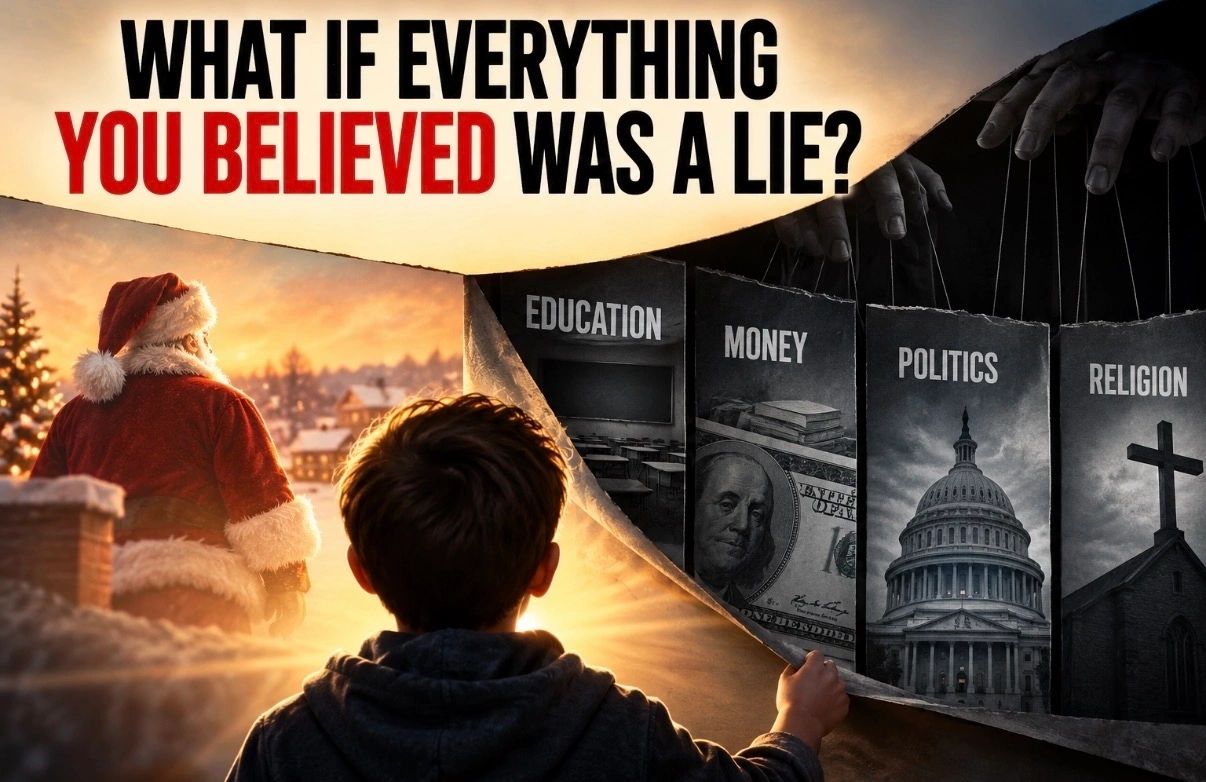
What if Everything You Believed Was a Lie?
If you are breathing, and if you are over the age of 2 years old, I can say with almost 100% certainty that you have been lied to at least one time in your life.
If you are breathing, and if you are over the age of 2 years old, I can say with almost 100% certainty that you have been lied to at least one time in your life.
Maybe you were lied to by a loved one, or maybe one of your children lied to you at one point or another because they knew they were going to be in trouble. Maybe you lied to one of your children about Santa Claus or the Easter Bunny.
Many years ago, when our oldest son was in 1st grade, my wife received a phone call from the principal. She said, “Mrs. Lavrenz, we have been getting some complaints from the other parents because your son has been telling all of the other kids that Santa Claus wasn’t real.” The parents were upset because their kids were coming home in tears because they were told that Santa wasn’t real.
As parents, all we could really do was laugh, but in all honesty, this situation triggered a conversation between my wife and me. What lies have we been told that only ever seemed to be little white lies, and worse, what lies have we told that we thought weren’t really a big deal?
Were the little lies we told about Santa Claus, the Easter Bunny, or the Tooth Fairy? Or were the lies we heard a deeper and more effective lie that kept us bound to a way of thinking or a way of doing things?
My goal in the next few paragraphs is to get you to take a hard look at some of the things that maybe you have been lied to about. My goal is to give you some examples of things that maybe you have believed to be true, or maybe to be a certain way, but instead, maybe that thing that you have believed was only a system of control or manipulation.
I’m going to highlight 4 different spheres of influence that affect every person’s life.
1 - Education
2 - Money
3 - Politics or Government
4 - Religion
Each one of these spheres of influence in our lives has an effect on us that maybe we never realized, but ultimately has a way of controlling us.
Let’s start with education.
Did you know that the education system as we know it today was built or designed to train workers? In the late 1800s and early 1900s, as the Industrial Age expanded across America, John D. Rockefeller was building one of the largest industrial empires in the world. With his enormous wealth and growing influence, Rockefeller helped establish the General Education Board.
There is a famous saying that has long been attributed to Rockefeller: “I don’t want a nation of thinkers, I want a nation of workers.”
The goal of the education system was not to educate, but rather to program a generation to memorize a system and punch a clock. The idea of reading, writing, and arithmetic became the goal of training students to punch a clock, do their work, and go home. The American worker was programmed to believe that it was a good thing to trade 40 hours a week for 40 years of their life so that they could receive a plaque or a watch at retirement and a pension until they die.
Never mind the fact that the worker had traded the best years of their life for a few dollars and a retirement party.
I often wonder why people trade a false sense of security for the deed to their freedom to travel or their freedom to go for a picnic on a beautiful day. Many times, in fact, you’ll hear of people dying only a short couple of years after their retirement. Did they die from disease or a sickness? Or did they die because their purpose was now gone?
Did their reason for living—the programming that they believed, that they were to go to school, get a job, work for 40 years, retire, then die—finally end?
Who told you that you had to do all that? Why did you believe that your purpose was wrapped up in a paycheck and a pension?
Speaking of a paycheck, let’s talk about the second sphere of influence in our lives: the influence of money and the financial system as we know it today.
Most people believe that the U.S. dollar is the best form of currency in the world. They believe this for various reasons. All oil is bought and sold using the U.S. dollar. Most foreign trade is done using the U.S. dollar. When you travel abroad, many countries will accept the U.S. dollar, even though their current system uses a different currency.
Did you know that since the inception of the Federal Reserve in 1913, the buying power has decreased around 97% to 98%? And did you know almost 90% of the buying power has disappeared since America was taken off the Gold Standard in 1971? Not sure what that means? All that means is that since 1971, the U.S. dollar has been backed by nothing. This means that all the U.S. government needs to do if it needs more money is print more dollars.
People wonder about inflation and how their dollars don’t go as far as they used to. It’s as if they are making less, or the goods and services that they are used to buying keep raising their prices.
Did you know that at the beginning of 2020, there were just over $4 trillion in circulation, and by October of 2021, that number had jumped to $20 trillion? That’s a 400% increase in the number of dollars in circulation.
No wonder your money is worth less. Basic economics says that if you have more of something, there is less demand for that thing.
For a number of years, there has been an argument that minimum wage is not a living wage and that there should be an increase in minimum wage nationwide. Those on the left would say that people can’t live on minimum wage, while those on the right would say that if we raise minimum wage, we would see hyperinflation. I think there is an argument for both.
Did you know that in 1964, which was the last year that dimes and quarters were made with real silver, minimum wage was about $1.20? Roughly the same value as the melt value of 5 quarters. By that logic, and as a fair comparison, minimum wage today should be close to $60. However, because there is no melt value and our money is backed by nothing, there is no guideline for what that basic living wage should be.
When we talk about left versus right in the political realm, we have been programmed in America to believe that we should vote Republican or Democrat. We have been programmed to believe that two choices are enough. In reality, we have been sold the illusion of choice.
I heard someone say over a decade ago that the left wing of politics and the right wing of politics are still the same wings of the same bird.
Many have called Washington the uni-party instead of two separate ideological belief systems. Democrats and Republicans will argue on the floor of the House all day long, criticize each other on television and in front of the cameras, then smoke cigars and drink whiskey in the same clubs later that night. They make us believe that they are doing their best to work with the other side of the aisle to come to an agreement on policy, when in reality, they are discussing plans to pad their pocketbooks and protect their own interests. They write laws that keep their paychecks intact for life, while they raise taxes that force people to work until they die.
When it comes to taxes that we pay as Americans, you can argue that the real tax that we pay in relation to the income that we earn, based on the system that we were programmed to follow, is closer to 60% or 70% as opposed to the 15% or 20% income tax that we believe.
If you want to understand how much you really pay in tax, you have to factor in everything that you are taxed on. You’re taxed when you earn an income, you’re taxed when you own a home, you’re taxed when you buy a good or a service, you’re taxed when you sell your home, and you’re even taxed when you die.
Did you know that when Americans were protesting British taxation during the historical event we all know as the “Boston Tea Party” in December of 1773, we were protesting not only “Taxation without Representation,” but we were only protesting a 7% to 10% tax on tea? A far cry from the tax that we are actually paying today without protest.
When the Pilgrims left England, one of the big reasons for leaving was that England did not have modern religious freedom. The Established Church of England was intertwined with the government, and people who rejected its practices could face fines, imprisonment, or other restrictions.
As part of the Mayflower Compact of 1620, those who first set foot in America from England wrote:
“Having undertaken, for the glory of God, and advancement of the Christian Faith and Honor of our King and Country, a voyage to plant the first Colony in the Northern Parts of Virginia, do by these presents solemnly and mutually in the presence of God and one another, covenant and combine ourselves together into a civil body politic, for our better ordering and preservation and furtherance of the ends aforesaid;”
The Pilgrims wanted to be free to worship the God of the Bible. They wanted to advance Christianity, not a state-sanctioned religion.
In many ways, what we have today in America and most Western cultures is a basic understanding that the way Christians should worship is by going to church on a Sunday, dropping our money in the bucket, singing a few songs, listening to a message, and going home.
I’m not saying this is wrong, but I wonder:
“Who made the requirement that church was the way we were to worship?”
Did you know that when Martin Luther nailed his 95 Theses on the door of the Catholic Church in 1517, he was ultimately challenging: Who has ultimate spiritual authority? How is a person justified before God? Is Scripture or church authority supreme? Can salvation of God’s grace ever be connected to financial payment?
Those questions helped ignite the Protestant Reformation.
Today, many of us are submitting to the same format that Martin Luther was protesting without even realizing it.
We drop our offerings in the bucket with hopes that God sees and rewards us for our behavior.
We see the preacher as the ultimate authority as opposed to the Scriptures.
We listen to the talking head on the Christian TV network as the ultimate authority instead of the Bible.
Ultimately, when we begin to look at the beliefs that we have formed in whatever sphere we decide to scrutinize, we begin to see that maybe what we have been told is not really the truth after all.
Maybe the best teacher for our children is not the education system that we have been sold.
Maybe the financial system that we have become a slave to is not the best system for you and me to trade our goods and services with.
Maybe the politician that we are voting for is only a smokescreen for a uni-party selection.
Maybe the way we have been told to worship is not the best option to worship our Creator.
Maybe our children would learn more if we taught them ourselves.
Maybe our money would be better off in a system that has a limited supply or is backed by something tangible.
Maybe our political system needs to break so we can get back to its original intent of “We The People.”
Maybe, if we began worshiping God on our own instead of waiting for the worship team to sing their songs, we would share our faith with others instead of waiting on the preacher.
Remember the story I told at the beginning about Santa Claus?
As children, many of us believed in Santa Claus for one simple reason: the people we trusted told us he was real. We didn’t question it. We didn’t research it. We didn’t ask who created the story or why we believed it. We simply accepted it as truth.
Eventually, we grew up and discovered that what we had believed wasn't true.
But what if Santa Claus wasn’t the last thing we believed simply because someone told us it was true?
What if some of the things we believe about education, money, politics, religion, success, and even freedom are things we have never stopped long enough to question?
Maybe growing up isn’t just discovering that Santa Claus isn’t real.
Maybe growing up is having the courage to question everything we have been told, search for the truth ourselves, and decide what we actually believe.
So I’ll leave you with one question:
What lie have you believed about the system that you live in?