Sep 2026
Silence Speaks Louder Than Surrender
For years I repeat the same line — if you don’t vote, you don’t get an opinion. But the system has become so broken that I started to question whether my vote matters.
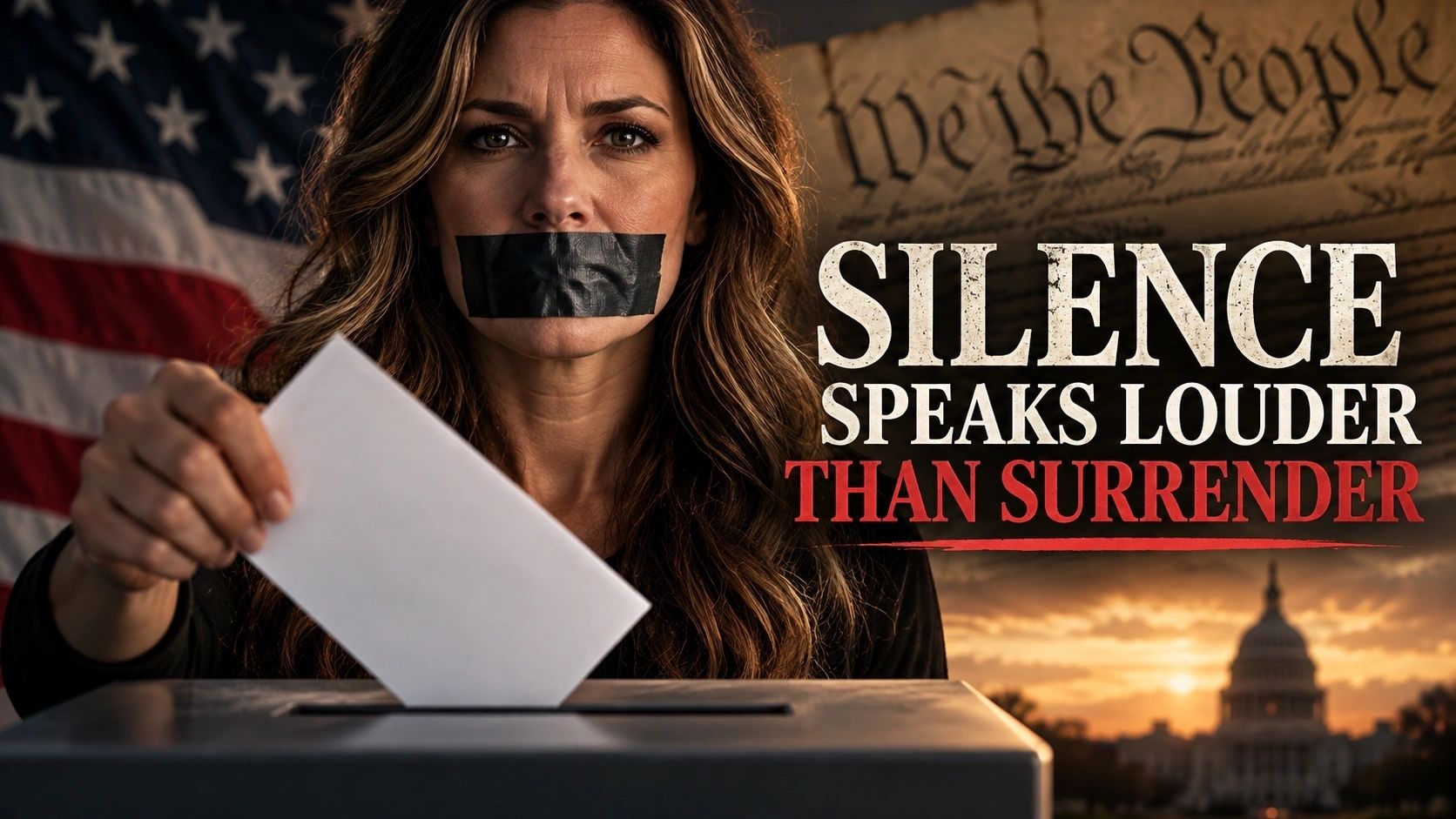
For a generation, as voting-aged Americans, we have been sold the line that “if we don’t vote, we don’t get an opinion.” When my father was alive, I remember sitting at the dinner table and hearing his strong opinion about why voting matters. He would argue that if you did not vote, then you could not complain about who was in office if you did not like that candidate. This has always been a strong opinion of mine as well.
In many respects, I stand by this opinion, but over the past few years, I have begun to question this idea. Not because I think we should surrender our vote, but because the system has become so broken that I have questioned whether or not my vote matters.
My first taste of the political realm, in my memory, was being a 16-year-old volunteer for the Jon Christensen campaign in 1994. Christensen won the 2nd Congressional District seat by defeating Democrat Peter Hoagland. I remember celebrating at the Red Lion Hotel in Omaha, Nebraska, with other volunteers and supporters. Being over 30 years ago, I don’t remember many of the details, and the old adage, “People don’t always remember what happened as much as they remember how something made them feel,” rings true. I remember the feeling of accomplishment and feeling like my small contribution made a difference.
After a second successful congressional term, Christensen decided to run for governor, took third in the GOP primary, and now practices law in the Washington, D.C., area.
I bring this small local history reference to attention because I was reminded of my introduction to politics while watching the raging dumpster fire of the Colorado governor’s race as it burns to ash. Add in the ongoing sentiments surrounding stolen elections, voter fraud, and concerns over voting without strict ID requirements, and I cannot help but wonder, “What have we become as a country?”
Twenty years after this introduction to politics, I repeated the same lines to my own children as they began to pay attention to the world they were stepping into. The talking points of the midterms in 1994 were focused on the Democrat push for universal healthcare, guns, God, gays, and reform of the welfare system. Not much had changed with the conversations I was having with my own children. The bulk of the controversial Obamacare provisions had just taken effect, and guns, God, and transgenderism were in the face of every American as Donald Trump descended the escalator of Trump Tower in New York City to announce he was running for president.
For the first time in two decades, I was ready to get involved again. Not because I wasn’t paying attention for 20 years, but because I watched a man who had it all put his hat in the ring to run for office. I watched as a billionaire who was about to turn 70 gave up every bit of anonymity that he had left to make a run at the presidency. For decades, Trump had made deals, closed sales, and rescued failing businesses and real estate projects. One of them was the Wollman Ice Rink in New York City, which had already taken six years and $12 million to renovate. When he took over the project, it was completed in just four months and under budget. This story, and many others, is highlighted in his book, “The Art of the Deal.”
In August of 2020, I had the honor of attending Trump’s nomination acceptance at the White House as conservatives from all over the country gathered to support the abrasive candidate who had disrupted the political scene with a highly unexpected win four years earlier. Leaders in faith, business, and many other spheres of influence gathered to show their support for the President as he accepted the Republican nomination for the upcoming election.
With high expectations, we cheered as the President gave his acceptance speech. With emphasis on law and order, his continued defense of his pandemic response, border security, and appointments of conservative judges, Trump encouraged the many influencers that when he was elected, he would finish what he had started to Make America Great Again! Little did we know that two months later, a shift in the way America sees its elections would take place, and the exposure of election integrity would take center stage.
On election night, we watched as every major news network stopped reporting results, and what looked like an inevitable second term turned into 75 million angry Americans. Not because their candidate lost, but because blatant fraud had just been committed. A candidate who never left his basement during his campaign and could hardly fill a high school gym when he did had apparently received 15 million more votes than any candidate in the history of America.
This is the night that politics would change forever. Voter confidence was now as fragile as trust itself. Hard-earned and easily lost. The election process found itself in a place where it had seldom been, with many states disputing the results and culminating with Congress certifying the results in the early morning of January 7 after hundreds of thousands of citizens descended on the Capitol to voice their frustration and exercise their First Amendment right to petition the government for a redress of grievances.
January 6, 2021, will forever be remembered in the history books of America, and depending on which side of the political spectrum you lean, your opinion of that day will lean toward the Constitution doing its job or an attempt to disrupt the constitutional transfer of presidential power.
Many Americans were hoping for Vice President Mike Pence to intervene, delay the count, and send the matter back to state legislatures for additional consideration. Instead, as I and potentially a million others stood outside the Capitol building with tear gas and rubber bullets being shot at us, we waited patiently as Pence refused to use his position to stop or delay the electoral count.
For four years, we watched as our borders were left wide open, American energy was canceled when the Keystone pipeline was closed, many lost their jobs, and our oil reserves were depleted. Leftist ideology began to dig its heels into the soil of arguably one of the greatest nations to ever exist. Praying grandmothers like my mother, Rebecca Lavrenz, were arrested and tried without proper evidence being allowed. Hard-working men and women who only wanted the chance to be heard were silenced. Not because their voices weren’t important, but because they were in fear of becoming another example. Gold Star moms like Tina Peters had their homes raided for exposing voter fraud. Men like Tom Hamner lost their thriving businesses while spending over two years in prison because they took plea deals hoping for lesser sentences.
Politics can be a dirty, nasty game where the worst in people comes to the forefront. Those who would rather serve their own financial goals and dreams of power become possessed with wanting to rule and reign over the very individuals who “voted” them into office.
Or did they?
I have observed over the course of the last 10 years that politics brings out the ugliest in everyone. It does not make a difference if you lean left or if you lean right. There seems to be a dark cloud that hovers over every conversation and a tendency to argue in defense of one’s opinion at all costs.
Instead of valuing the opinions of others, we fight for ours. Instead of listening to hear, we listen until we have a chance to speak our minds. We would rather tell someone with an opposing view that they are wrong rather than listen to what they have to say and engage in civil discourse.
What we have experienced in America is a breakdown of the soul of our nation. Only 25 years ago, all you had to do was walk out the front door after 9/11, and almost every home on the street had an American flag hanging on the front of the house. American pride was at an all-time high. Today, many individuals argue that our flag is a symbol of oppression. They argue that because our nation is a nation of immigrants, our nation should be a nation of all immigrants. Legal or illegal doesn’t matter in the eyes of many. Never mind that many reports have stated that the real number of illegal aliens who crossed the border during the Joe Biden presidency was north of 20 million, with many being military-aged men. Individuals were flying from the Middle East to Central America and Mexico and walking across the border.
America is not just an idea or an experiment. She was created with a purpose. A group of people were tired of a king. They wanted sovereignty. They saw an opportunity to live free. To live as God intended for them to live. With their own voices. With their own opinions and their own consequences. Unfortunately, even though we walked away from King George and declared our independence in 1776, we still bend our knee to men. We continue to gravitate toward those who would rather hold a position of power than serve those who gave them their vote.
America was founded on the principle of “We the People.” Today, many God-fearing, patriotic Americans wear this slogan on T-shirts and hats. We have it plastered on our vehicles, and we wave it on flags for all to see. But do we really understand what that means?
When the Constitution begins with “We the People,” the central idea is “popular sovereignty.” Legitimate governmental authority originates with the people rather than with a king or with government officials themselves. The Library of Congress describes the phrase as asserting that the nation’s power arises from the people, and Constitution Annotated identifies “the People” as the source of the Constitution’s authority.
Sovereignty means “having the authority to govern yourself rather than being governed by the will of another.” At its core, this means we have the freedom to choose. We have the God-given right to decide how our voices will be heard. Do we speak louder? Do we protest? Do we petition the government for a redress of our grievances? Do we cast our vote for the candidate who best represents us?
The Constitution protects many of the avenues for political expression. But somewhere along the progression of the American story, I believe we have confused the right to choose with an obligation to choose from the options we are given.
If sovereignty means anything, shouldn’t it also mean that we have the freedom to say, “None of these choices represents me?”
Many discussions have been given to this very topic over the course of the past few months as Colorado has argued over who the best candidate for governor is this year. A very heated primary converted to a very divided Republican Party that has seen its candidate, Victor Marx, draw much criticism not only from those on the Democrat and Republican sides, but also from those within the party. Good people who would have otherwise gotten along are suddenly enemies.
Many conservative voters have decided that in this year’s midterm election, they will vote independent, as they are not happy with the Republican candidate. Many supporters of the Republican candidate have attacked those who have made their decision to vote independent and accused them of voting for the Democrats and all that is evil if they don’t vote for the “R.” Others have stated that they would vote for the lesser of two evils if it meant they would vote the Republican, Victor Marx, into office.
My response to those who have said that they would vote for the lesser of two evils is that evil is still evil. I’m not saying that Victor Marx is evil. I have never met the man, and even though many have said he is an evil person, a liar, and a con man, I refuse to place a label on someone that I have never met and, until a year ago, knew nothing about.
In a recent post on social media, I made the statement that until election integrity is fixed and the right people are behind bars, there will be no Republican governor in Colorado. I followed up the statement by saying that I might sit out this election.
This has been a very difficult decision for me because of my belief system and because of how important it is for me to use my voice to stand up for what I believe in. But I have come to the conclusion that until we fix our broken system, elections will not be free and they will not be fair. The statistical anomalies that have repeatedly happened in recent primaries and in general elections have shown me that it does not matter who votes, but who counts the votes that matter. By the way, that statement is not my own. It was originally made by Joseph Stalin.
I have heard many people who have recently gotten involved in the Colorado political scene say that if we don’t vote red all the way down the ballot, we will lose Colorado. I don’t disagree with that as a whole. If conservatives don’t get into office, we will definitely lose our state to leftist ideology, but where I think people have failed to observe is that Colorado was lost a long time ago. For almost two decades, our state has voted blue, and this was pretty apparent in this year’s primary, as approximately 1.5 million people voted, with around two-thirds voting Democrat. Not exactly a close race.
I strongly believe that the good people of Colorado really do have conservative values and want conservative politicians in office, but without election integrity, safe elections, same-day voting, no mail-in ballots, or hand counts, we will never have a Republican governor. I really hope I’m wrong.
Recently, someone challenged my position with an analogy. He asked me to imagine that I had cancer and was offered a treatment that was itself toxic but could slow the progression of the disease. His point was simple: You may not like the Republican candidate, but refusing to vote for him could allow the opposing political agenda to advance more quickly. In his view, voting for someone you don't particularly want is not an endorsement—it is an attempt to slow something you believe would be worse.
I understand the argument.
But it also exposes the question at the heart of this article: How many times are we willing to vote against what we fear rather than for what we believe?
If I continually surrender my convictions because I am told the alternative will be worse, at what point am I no longer choosing at all?
Politically speaking, I struggle with the idea that my only options must always be the lesser of two evils. If I believe both choices require me to compromise something fundamental, telling me that one is less harmful does not suddenly make that choice good.
Poison may differ in dosage, but calling one option less poisonous does not make it something I willingly want to consume.
And that brings me back to sovereignty.
If my vote truly belongs to me, then I must also have the freedom to say that neither fear nor party loyalty is enough to earn it.
I refuse to surrender by giving my support to someone I do not support only because they are the lesser of two evils. Instead, I choose to remain silent. Not because I don’t have a voice, but because I do have a voice.
My father taught me that if I didn't vote, I didn't have a right to complain about the person who was elected. For most of my life, I believed him without qualification.
Today, I still believe my voice carries a responsibility. What has changed is my understanding of how that voice can be used.
A sovereign people must have the freedom to say yes. We must have the freedom to say no. And we must have the freedom to say that none of the choices placed before us has earned our consent.
My silence is not the absence of a voice.
It is the exercise of one.
Sometimes silence speaks louder than surrender.