
Oct 2026
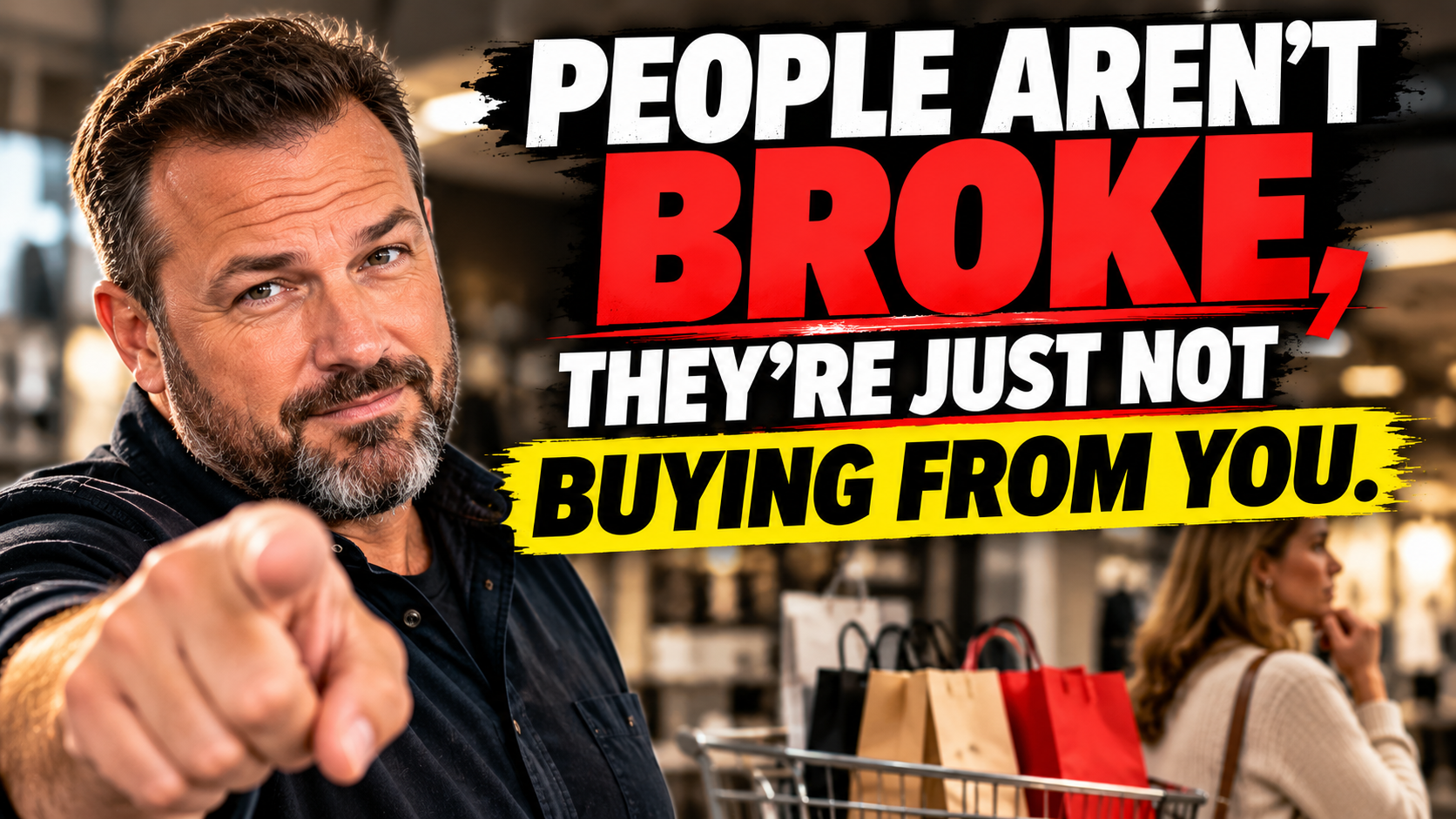
People Aren’t Broke. They’re Just Not Buying From You.
People are still spending money. Before blaming the economy, examine how well you connect, build trust, communicate value, and ask for the sale.
“I can’t afford it.”
If you’ve spent any amount of time in sales, you’ve heard those four words.
Maybe it was followed by:
“It’s too expensive.”
“I need to think about it.”
“We need to wait.”
“I need to talk to my spouse.”
And when we hear those objections enough, it becomes easy to blame everything around us.
The economy.
Inflation.
Interest rates.
Bad leads.
Competition.
The price of our product.
But what if we’re blaming the wrong thing?
What if people aren’t broke?
What if they’re just not buying from you?
That’s a harder question to ask because it forces us to stop looking at everything we can’t control and start examining the one thing we can:
How well are we selling?
“I Can’t Afford It” Doesn’t Always Mean “I Don’t Have Money”
People are still spending money.
They’re taking vacations. They’re buying cars. They’re eating at restaurants. They’re upgrading their homes. They’re buying electronics. They’re investing in things they believe will improve their lives.
So when someone tells you, “I can’t afford it,” what are they really saying?
Sometimes they truly don't have the money.
But sometimes what they mean is:
I don't see enough value to spend my money on this.
When they say, “It’s too expensive,” they may actually be saying, “I don’t see the value.”
When they say, “I need to wait,” they may really mean, “I’m not convinced yet.”
When they say, “I can’t afford it right now,” what they may be telling you is, “This isn’t a priority for me.”
That changes the question.
Instead of asking, “Why don’t they have the money?”
Ask:
“Why haven't I given them a compelling enough reason to spend it with me?”
A Tough Economy Doesn't Make Selling Impossible
Economic pressure is real.
People feel inflation. Housing costs more. Food costs more. Interest rates affect purchasing decisions. Families are paying closer attention to where their money goes.
But tighter budgets don't mean people suddenly stop buying everything.
They become more selective.
And that means something important for salespeople:
When money gets tight, selling doesn't become impossible. Mediocre selling becomes harder.
A strong economy can hide weak sales habits.
A difficult market exposes them.
If you struggle to get appointments, the market will expose it.
If you struggle to communicate value, the market will expose it.
If you can't handle objections, the market will expose it.
If you're afraid to ask for the sale, the market will expose it.
That's not necessarily bad news.
Because those are skills.
And skills can be improved.
Why Do People Buy From You?
After decades in direct sales, I've come to believe there are three fundamental reasons people buy from you:
1. They Like You
People want to do business with people they like.
That doesn't mean you have to become everyone's best friend. It means you need to create a genuine human connection.
I recently finished a sales presentation where the customer had already told me no several times.
I had packed everything up.
The presentation was essentially over.
Then we started talking.
We talked about his house. His health. Money. Politics. Cryptocurrency. Things we had in common.
About thirty minutes later, he asked me another question about the product.
Eventually I looked at him and essentially said, “You obviously like me. At least buy something from me.”
And he did.
What changed?
The product hadn't changed.
The price hadn't changed.
The relationship changed.
That's why I've taught salespeople for years to find the fish on the wall.
Walk into someone's home and pay attention.
Maybe there's a picture of a giant fish on the wall.
Ask about it.
Maybe there are pictures of their children.
Ask about them.
Maybe they collect something.
Ask how the collection started.
Maybe there's sports memorabilia.
Ask about their team.
You're looking for common ground.
You're looking for the thing that makes the presentation stop feeling like a transaction and start feeling like a conversation.
2. They Trust You
Connection opens the door.
Trust lowers the risk of walking through it.
People hesitate when they don't trust the salesperson, the company, the product, the process or the decision they're about to make.
Your job is to remove as much uncertainty as possible.
Don't pressure someone into trusting you.
Give them reasons to trust you.
Listen.
Ask questions.
Pay attention.
Follow through.
Know your product.
Don't hide important information.
And make the buying process feel safe.
The more trust you establish, the less frightening the decision becomes.
3. They Understand You
This may be one of the most overlooked parts of selling.
Confused people don't buy.
You might understand your product perfectly.
That doesn't mean your customer does.
What are they getting?
How much does it cost?
What problem does it solve?
What happens next?
How does payment work?
When will they receive it?
Why should they choose this instead of something else?
And most importantly:
What's in it for them?
One of the acronyms I've used in sales is WIIFM: What's In It For Me?
That's the question running through your customer's mind.
They don't care that you need another sale.
They don't care about your mortgage.
They don't care about your car payment.
They want to know:
“What does this do for me?”
Your job is to answer that question so clearly that making a decision becomes easy.
Value Has to Exceed Price
Price isn't evaluated in a vacuum.
Customers compare what they're giving up with what they believe they're receiving.
If the perceived value is greater than the perceived cost, the purchase starts making sense.
That's why simply defending your price isn't enough.
Your job isn't to justify the price. Your job is to establish the value.
What outcome does your product create?
What problem does it solve?
How much time could it save?
How much money could it save?
What inconvenience does it remove?
What happens if the customer does nothing?
What becomes possible if they say yes?
These are the questions that move a sales conversation away from:
“How much does this cost?”
and toward:
“Is what I'm getting worth what I'm giving up?”
Stop Talking So Much
One of the biggest mistakes salespeople make is trying to talk themselves into a sale.
The customer hesitates.
And we panic.
So we explain another feature.
Then another benefit.
Then another story.
Then another discount.
Then another reason they should buy.
Stop.
Selling isn't talking. Selling is understanding.
You need to uncover:
The need: What do they want?
The problem: What's not working?
The consequence: What happens if nothing changes?
The desire: What would a better outcome look or feel like?
The motivation: Why should they do something now?
You don't uncover those things by giving another ten-minute presentation.
You uncover them by asking better questions.
And then listening.
Objections Aren't Always Rejections
“I need to think about it” doesn't necessarily mean no.
It may mean there's an unanswered question.
“It costs too much” may mean they haven't seen enough value.
“We're going to wait” may mean there isn't enough urgency.
“I need to talk to my spouse” may mean another decision-maker needs to be involved.
Instead of immediately fighting an objection, diagnose it.
Find out what's underneath it.
Sometimes the most powerful thing you can do after asking for the sale is simply be quiet.
Let them think.
Let the silence become uncomfortable.
Because somewhere inside that silence, you may finally hear the real objection.
Audit the Sale Before You Blame the Customer
Before blaming the economy, price, customer or leads, ask yourself:
Did I uncover the real problem?
Did I connect my solution to something that actually matters to them?
Did I clearly establish the value?
Did I reduce uncertainty?
Did I create a legitimate reason to move forward now?
Did I actually ask for the sale?
And did I listen when they answered?
Fix the process before blaming the market.
Mindset. Skillset. Toolset.
A mentor once explained sales problems to me in three categories:
Mindset. Skillset. Toolset.
Maybe you have the right tools but the wrong attitude.
Maybe you have a great mindset but haven't developed the skills.
Maybe you're talented and motivated but you're using a broken process.
You need all three.
Your mindset determines how you approach the opportunity.
Your skillset determines how effectively you handle it.
Your toolset helps you execute consistently.
So when sales aren't happening, don't immediately assume the market is broken.
Ask which one needs work.
Three Things to Take With You
First, stop blaming the economy and focus on what you can control.
You can't control inflation. You can't control interest rates. You can't control what your competitors do.
You can control your attitude and your activity.
Second, increase perceived value.
Give people a compelling reason to choose you.
And third, become better at selling.
Train.
Study.
Practice.
Ask better questions.
Improve your presentation.
Improve your follow-up.
Get better at asking for the sale.
Because a difficult market doesn't necessarily mean people have stopped buying.
It may simply mean they've become harder to convince.
And that brings us back to the uncomfortable question every salesperson should be willing to ask:
Are people really broke—or have we gotten worse at giving them a reason to buy?
People are still spending money.
Someone is earning their business.
Why shouldn't it be you?
Want to Become Better at Selling?
Join me inside The Revenue Room, where we talk about the mindset, skillset and toolset required to become better at sales and build a stronger business.
The Revenue Room:
https://michaellavrenz.com/revenue-room
More from Michael Lavrenz:
https://michaellavrenz.com
Build it like it matters. Sell it like you mean it.